The operating system that decarbonises the food supply chain
Califrais builds AI that decides, not just predicts. An agentic platform born from French academic research, orchestrating the operations of food wholesalers, logistics providers, distributors and wholesale markets.
What we do
Operate. Equip. Orchestrate.
Three complementary areas of expertise, one strategy: give the whole food chain the means to decide better, faster, with less CO2.
Expertise 01 · Unique knowledge of the field
A real market as our laboratory.
Since 2021, Califrais has been the official digital and logistics operator of the Rungis International Market, the world's largest fresh-food market. On RungisMarket.com, 150 wholesalers meet 3,000 professional buyers: every order, every route, every product feeds and tests our algorithms.
TimeOrderRoute
- Restaurant · Paris 11th · 14 casesHGV #37
- Caterer · Boulogne · 32 kg seafoodVan #24
- Hotel · Paris 8th · 9 cases dairyHGV #37
- Institutional catering · Ivry · 120 kgHGV #12
- Restaurant · Vincennes · 6 cases meatVan #58
Illustration
Expertise 02 · The agentic platform
Twelve agents, from order to delivery.
Order capture, demand forecasting, replenishment, picking, routing, pricing: switch agents on one by one or together. They are built for fresh-food constraints such as use-by dates, frozen goods, massive volumes and more.
- OMS agent captures orders received by email, WhatsApp and voice message.
- TMS agent optimises fleets then routes, adds a logistics pooling layer and sends out route sheets.
- Guide agent paces picking to the departure times of each wave of trucks.
- Stock agent recomputes purchase proposals for short shelf-life products.
- Pricing agent adjusts dynamic pricing strategies to the day's market rates.
Illustration of a typical sequence
Expertise 03 · The intelligence of a network
Optimised, pooled strategies.
Our platform enables a network of actors (for example a multi-site distributor, a wholesale market, etc.) to adopt optimal collaboration strategies that cut the cost per kilo and emissions, for instance by pooling upstream and downstream logistics.
Who it's for
One platform, four trades.
Every actor in the chain has its own goals, constraints and dynamics. Our agents fit yours.
Wholesalers
Automatic order capture, forecasting, guided picking, routes, market prices, etc.
Discover SolutionsLogistics providers
Optimised and pooled routes, picking, load rates, measured emissions, etc.
Discover SolutionsDistributors
Forecasting and replenishment under supplier constraints, bespoke algorithms, etc.
Discover SolutionsWholesale markets
Digitise, pool and decarbonise the flows of an entire market, etc.
Discover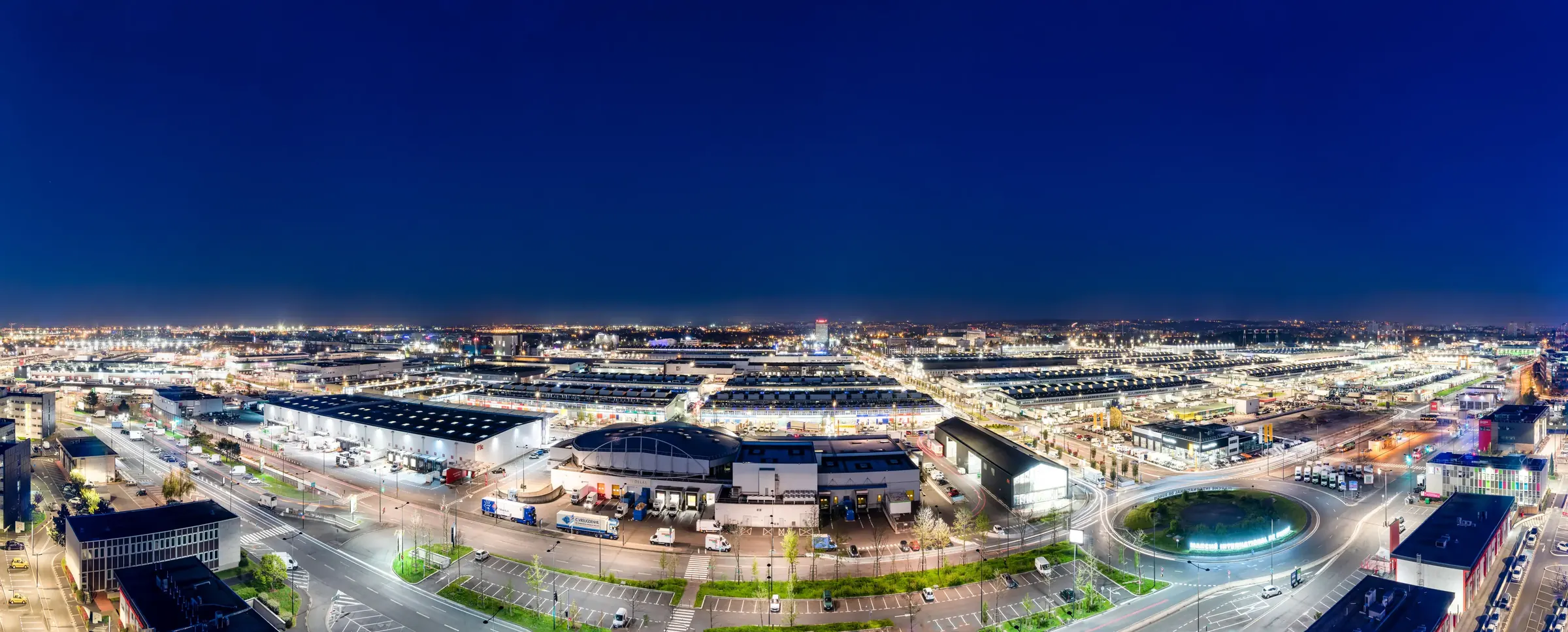
What is already proven
Measured results, not promises.
Service rate
vs 87% sector average
Less food waste
Flows operated at Rungis
Less CO2 emitted
Flows operated at Rungis
Transport costs
Flows operated at Rungis
Stock-outs
At major European retailers
The Rungis International Market, proving ground for our algorithms since 2021.
Our positioning
An ecosystem that grows, learns and improves continuously.
We are neither a generic software vendor nor a consultancy cut off from reality. Our technologies are born in the field, designed to answer each challenge in the chain optimally, and grow more powerful with every iteration.
- 01
Operations create data.
In-depth field knowledge and an understanding of real flows are essential to structure data correctly.
- 02
Data creates the technological edge.
Our algorithms are trained and validated on real decisions, with precise modelling of the system's constraints and dynamics.
- 03
Technology creates the network.
Every new agent enriches the platform and amplifies the network.
- 04
The network creates the infrastructure.
At the scale of a multi-agent organisation, Califrais becomes the orchestration layer that creates synergies between agents.
Our R&D DNA
Science, tested in the field.
Since 2014, Califrais has been taking AI from promise to proof. Our R&D model brings our teams together with France's leading academic laboratories around one vision: decarbonising the food supply chain.
- 2014Califrais is founded and our research begins
- 200+Researchers and professors involved in our work
- 15PhDs in AI on our teams
- 12Academic laboratories we work with every day
Published where science happens
- ICML 2026Latent Guided Sampling for Combinatorial Optimization
- NeurIPS 2025Wasserstein Convergence of Critically Damped Langevin Diffusions
- NeurIPS 2024Non-asymptotic Analysis of Biased Adaptive Stochastic Approximation
- ICML 2024Dynamic Survival Analysis with Controlled Latent States
- NeurIPS 2023Online Inventory Problems: Beyond the i.i.d. Setting with Online Convex Optimization
- ICML 2023Learning the Dynamics of Sparsely Observed Interacting Systems
















Why now
A vital sector, in full transformation.
Three trends make the replenishment logic used until now obsolete.
A largely under-equipped sector.
Ageing solutions, poor visibility on flows, little pooled logistics, pressure on margins and growing decarbonisation demands.
Regulatory and economic pressure.
Mandatory decarbonisation, thin margins, energy and economic crisis: managers are actively looking to modernise to stay in the race.
Complex signals.
Climate hazards up fivefold in 50 years, time-series data (demand, prices, etc.) ever more stochastic: very high-dimensional, highly constrained and random signals. History is no longer enough.
Two essential responses
What the food supply chain must be able to do, starting today.
Adapt in real time
Use every available variable, far beyond last year's history.
Optimise the whole chain
Make every kilometre driven and every kilo stored count: model suppliers, warehouses and points of sale together.
Decarbonising the food supply chain is no longer only an ecological issue: it is an economic one.
Because in the 21st century, waste is a collective failure.
Ten years of R&D, ready to switch on now.
They support us